Revisiting the Drake equation
If you're interested in space or alien life, chances are you've seen the Drake equation. As a refresher, here's what it looks like:
N = R* × fp × ne × fl × fi × fc × LThis equation is meant as a veeeeery approximate guess for how many alien civilizations that we can communicate with may currently exist in our galaxy. Many people have tried to "solve" it by assigning whatever value they find realistic to each factor in it. Years ago, when the equation was still fairly popular, pretty much every factor had to be a wild guess since we didn't have a lot of real data on them. Now that a bunch of scientific progress has happened, I felt like giving it a shot myself. Of course, the result may be very far from reality - we won't really know until we've actually made contact with alien intelligence. This will involve some of my own unprofessional opinions.
So, let's go over the factors and what is known about their values.
N = how many worlds will respond to us
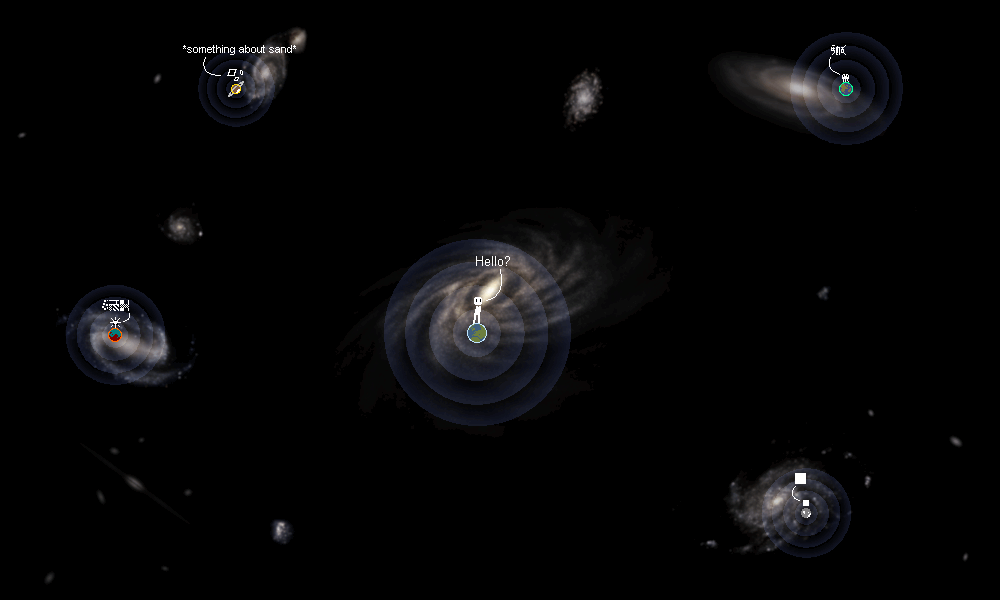
N is the number we're looking for - the number of alien civilizations we can communicate with at any given time. Estimates I've seen over the years range from the tiniest fraction of one to several million. We could be alone in the entire observable universe, or we could have tons of neighbours just waiting to start communicating (which is frankly hard to believe, since we probably would have already done that). I'll try to find an absolute maximum for that number given the highest values that are in my opinion still reasonable. Don't get your hopes up.
R* = how many suns ignite each year
More accurately, this is the average number of stars born in the Milky Way per year of its history. The oldest stars in our galaxy are about 13.5 billion years old, and the Milky Way contains some 100-400 billion stars, let's say 300 billion, most of which are low-mass dwarfs that live much longer than the Galaxy has existed thus far, so simply dividing the number of stars in the Galaxy by its age brings us somewhat close to the actual estimated yearly rate of star formation, at least by physicist standards - ~20 versus 1-3 according to the Wikipedia article I linked above. Just one order of magnitude off!
According to other sources, the number could go as high as 7. I'll be optimistic and say it's 10, to potentially account for all the stars we have yet to discover and for any brown dwarfs or black holes that are, by chance, capable of hosting habitable planets. It's also important that this number is an average over the Galaxy's whole history, which is pretty difficult to find out, but the numerous galaxy collisions our Milky Way must have gone through would probably bump the average yearly starbirth rate up to something like my estimate. So R* = 10.
fp = fraction of stars with planets
This one's seen a lot of improvement - 35 years ago we weren't even sure if there were planets around any stars besides our own (though it seemed likely), but since then we've been finding more and more exoplanets orbiting more and more stars. The current consensus is that practically all but the most massive and short-lived stars have planetary systems. We can safely put this fraction at 1 or higher. Heck, the number of rogue planets in the Milky Way is thought to be several times more than that of bound planets or stars! Screw it, let's put fp at 10 as well. This means that about 100 average solar systems' worth of planets appear in the Milky Way each year.
ne = number of habitable planets per system
This is the first one that's tricky and relies more on opinion than data. We're still far from figuring out how many planets in our neighbourhood can be considered "habitable" - it's hard enough to find out if an exoplanet even has an atmosphere. Proxima b is one of the nearest extrasolar planets to us and we don't even know if that has an atmosphere, since it doesn't eclipse its star (and thus refract its light, allowing us to study what gases surround it) from our perspective.
A planet that orbits in its star's "habitable zone" - a distance where a planet can host liquid water provided it has a substantial atmosphere - is often considered a better candidate for habitability than one that doesn't. But that's habitability for life as we know it. Meanwhile, even Earth has some organisms that can survive in seemingly inhospitable environments, called extremophiles - tardigrades are a famous example. I believe it's plausible that a whole ecosystem of such beings could emerge on some worlds, so we should maybe take them into account when finding how many alien friends we could have. They could be like the cool, tough guys of the galactic community.
This factor can also be understood as the average number of planets per system that had the right conditions for life as soon as they had cooled after their formation. For exoplanets, this is nigh unknowable. However, we've studied our own Solar System enough to perhaps make somewhat of an educated guess.
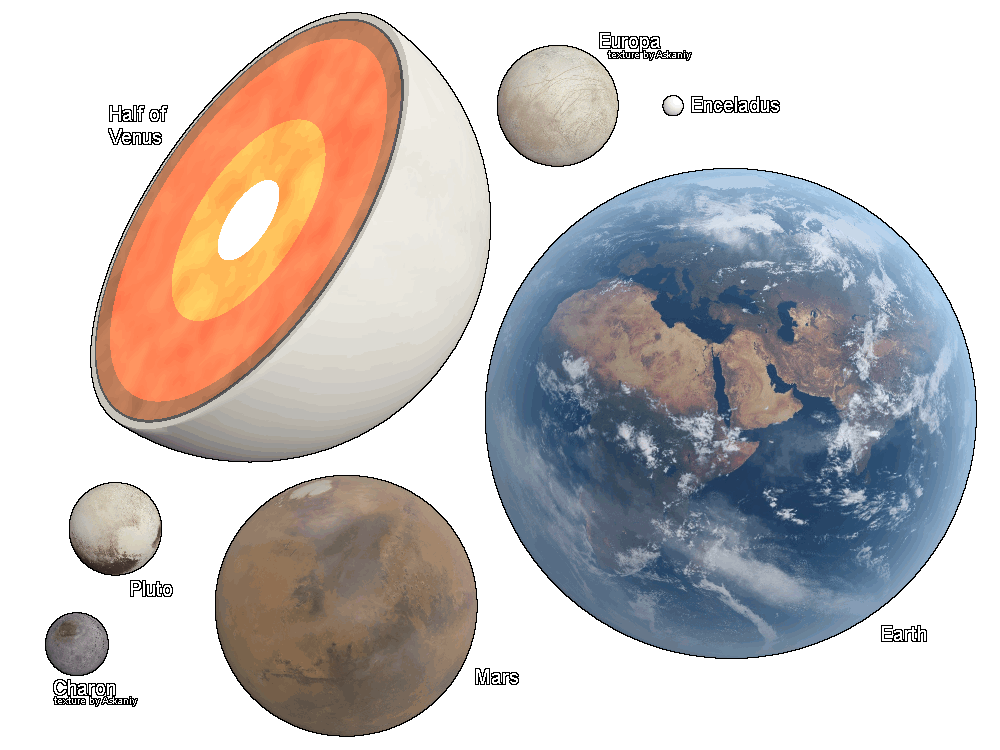
Earth is the only planet orbiting Sol that has remained (more or less) habitable for its entire history. It is, however, believed that the other terrestrial planets, as well as some gas giant moons, were more hospitable in the past than they are today. Mars almost certainly used to have oceans before it became too cold and too much of its atmosphere escaped into space. Early Venus is a mystery due to the planet's high geologic activity, but it's possible it was a nicer place in the past as well - let's count it as half of a habitable planet. Jupiter and Saturn's large moons (especially Europa and Enceladus) are well-known for being balls of ice with possible oceans of liquid water inside them created by tidal heating from their parent planets' gravity, and there's a chance those were even more exciting environments back when they were warmer. Finally, I'd also consider icy dwarf planets with large moons such as Pluto, Orcus or Salacia, as well as said moons. Okay, let's say the worlds in our Solar System that were capable of developing life at some point are Venus, Earth, Mars, Europa, Enceladus, Pluto and its moon Charon. That gives us a very optimistic 6.5 "habitable" worlds. Let's stick with that. 100 × 6.5 = 650 habitable worlds per year of the Milky Way's history.
fl = fraction of those planets that are inhabited
Well, looking at our system again, it seems only one of those 6 and a half "habitable" planets is still habitable. If I had to crank up my optimism once again, I'd say that maybe there is some kind of primitive underground life on Mars surviving from when it still had oceans. The icy moons of Jupiter and Saturn have cooled down in billions of years, but I'm a little more hopeful about them. Pluto and Charon are probably the least likely of the bunch to still be habitable - it's real cold there nowadays. Venus is out of the question for exactly the opposite reason. That leaves us with a maximum of 4 inhabited worlds out of 6.5, a fraction of about 0.6. All in all, my biggest hope is that there's some basic microscopic life in our Solar System alongside the sprawling biosphere of our own planet. 650 × 0.6 = 390 of those yearly "habitable" worlds have actually developed and sustained any kind of life.
fi = fraction of those planets with intelligent life
This one is even tougher, and about where it gets depressing. To know this one, we would pretty much have to actually find a whole bunch of inhabited planets and do a galaxy-wide census. No way to accurately estimate this one.
For an educated guess, let's look at what we know again. Earth probably contains the vast majority of life forms in the Solar System even if it's not the only inhabited planet. Estimates for the number of living species that currently exist on Earth range from 2 million to 1 trillion, of which only one, Homo sapiens, has developed what it calls "sapience". Or three if Douglas Adams was right. Ignoring all the species that didn't make it through the past ~4 billion years, this means the probability of any species eventually becoming sapient, to our knowledge, is at best one in a million.
390 × 1/1,000,000 ≈ 0.0004 planets with intelligent life for every four hundred inhabited planets. At most. Oof.
Other estimates for this fraction tend to be much higher - between about 0.001 and 1. On one hand, some people believe that if life can develop and grow in complexity for long enough, the emergence of a sapient species is pretty much inevitable. On the other hand, life on Earth has gone through a lot of crap to get to where it is now - snowball Earth events, massive volcanic eruptions like the one that possibly caused the Great Dying, even the invention of photosynthesis is thought to have wiped out most earthlings at the time. These disasters would probably lower the value of fi quite a bit.
Well, let's bump our fi up to 1/10,000, just because we really want someone to talk to. Okay, maybe 1/20,000.
fc = fraction of civilizations that send signals into space
Each factor in this equation is more controversial than the last. This is the first one that pretty much entirely depends on your opinion. Humans invented radio communication more than a hundred years ago, and many of our signals, intentionally or not, have been leaking out into space that entire time. If by any chance there's an alien with a powerful radio antenna within a hundred light-years of Earth, they might perhaps possibly in a perfect world be able to tune into a political discussion in one of our strange languages. I don't know, let's make this one 0.5. Some intelligent species may leak signals into space at some point, some may not.
I would personally add another factor, which is how many of those civilizations we can actually detect. The problem with picking up our radio signals from light-years away is that you'll have to distinguish them from interstellar noise, which interferes with them more and more as they propagate through the Galaxy. With that in mind, let's put fc at 0.1. Because our technology frankly sucks.
L = how many years they transmit those signals for
This one speaks for itself. Humans have been leaking radio signals into space for a hundred years, but given our advances in finding practical applications for quantum phenomena, I have a feeling radio may fall out of fashion sometime this century in favour of a form of communication based on something like quantum entanglement. Maybe next century if we have some trouble getting it to work. I'd put this at an average 200 years for all radio-using civilizations.
Result
So, here's what we get:
N = 10 × 10 × 6.5 × 0.6 × 0.00005 × 0.1 × 200 = 0.39Well, looks like we're alone. Dang it.
Though again, many of these numbers are wild guesses and are probably vastly different in reality. And besides, this just means one in 2 or 3 average-sized spiral galaxies is home to a civilization transmitting signals that we could detect if we were in the same galaxy. Given the estimated 2 trillion galaxies in the observable universe, that comes out to 780 billion such civilizations in all of visible space, which doesn't sound so bad. There could be many civilizations in the Milky Way that communicate in ways we haven't even discovered yet.
I'm positive that life is more common in the Universe than most people think. My personal guess is that at least 5% of all planets are inhabited, just because if a planet forms in the right region of its system and is geologically active, at some point its environment will create some kind of complex process that may as well be a form of life. Whether intelligent life is common is a whole other question that involves defining what life forms we consider intelligent in the first place. I imagine the Universe is relatively populous with alien species that share some traits we consider beneficial for life in general, like cooperation, while vastly differing from any Earth life in every other way.
And who knows, maybe millions of years from now we'll be some of those incomprehensible aliens communicating via entangled particles, hidden in plain sight from those rare civilizations that still try to use radio signals to look for us. But that's okay. Just give them another century or two.