Continuing the cool diagram series, here's a sequence of drawings showing the scale of the Universe. You can navigate using the links next to the title.
x5 << 1 pixel = 625 km >> x20
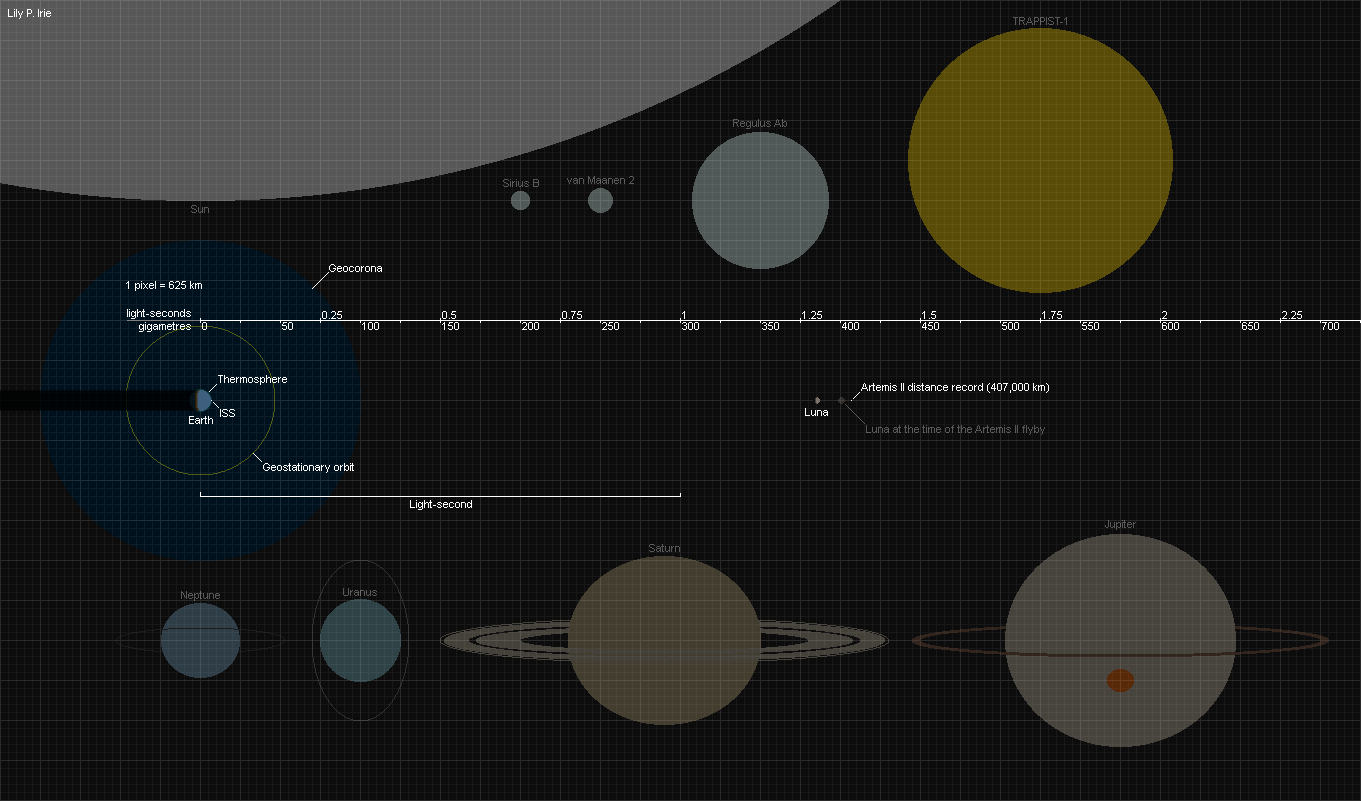
Here the scale is 5 times smaller than the previous page. A large asteroid like Vesta or Pallas would be one pixel wide here. The distance scale reaches 725,000 kilometres, which is just over the radius of the Sun. If the Earth were replaced with the Sun, its moon would end up somewhere in the latter's convective zone.
The giant planets and the actual distance to our moon Luna easily fit within the image. Luna is shown more or less at its average distance from Earth; during the Artemis II flyby mission it was a little bit farther away, close to its apogee (farthest point from Earth). Some of the smallest stars are shown as well - the relatively nearby white dwarfs Sirius B and van Maanen 2, the pre-white dwarf Regulus Ab and the famous "red" dwarf TRAPPIST-1.
Each of the four giant planets possess ring systems, the brightest parts of which are included here. Saturn has by far the most noticeable rings - the bulk of them is about 280,000 kilometres in diameter, more than twice as wide as the planet itself. There are also much fainter, wider rings of dust situated way further out from the planet.