Here's a sequence of drawings showing the scale of the Universe. You can navigate using the links next to the title.
x10 << 1 pixel = 125 million km >> x500
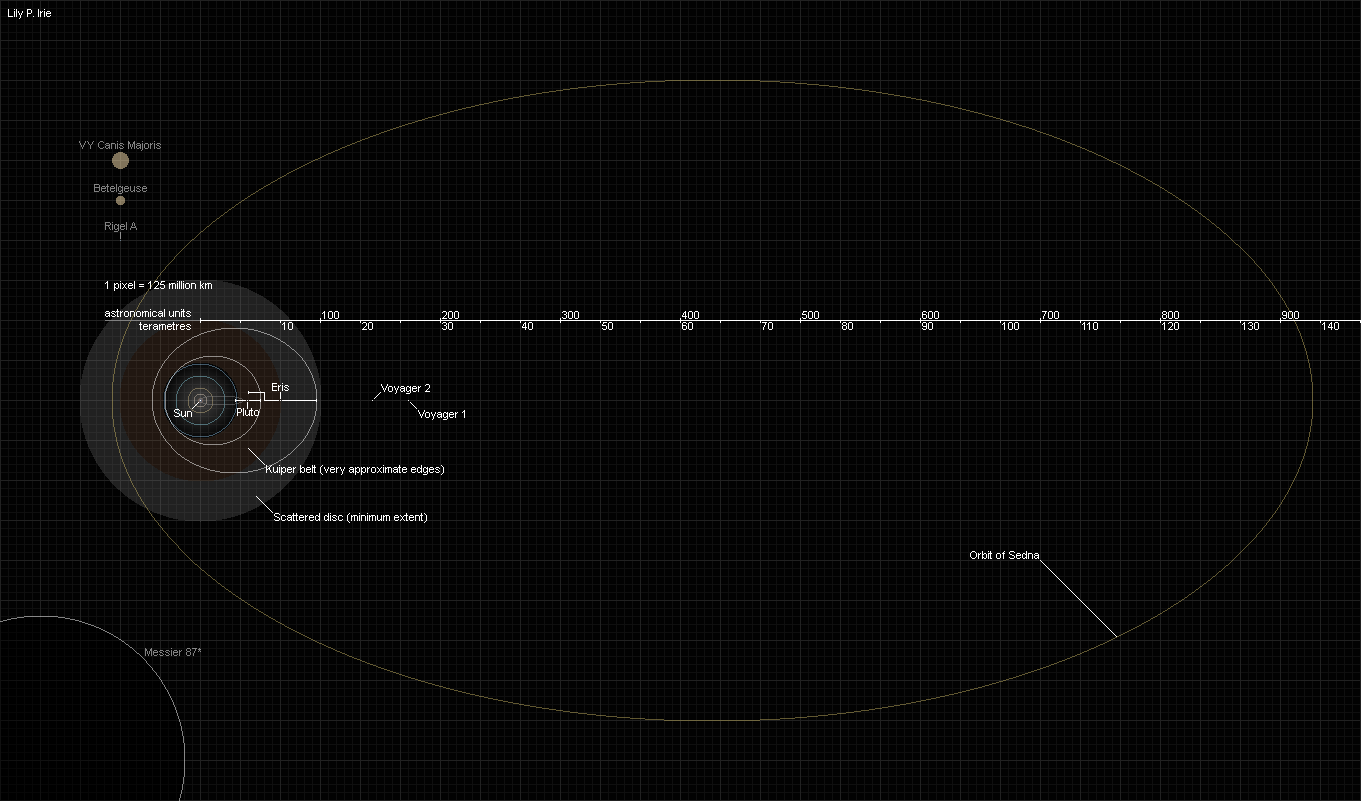
At this point the distance from the Sun to the Earth is so negligible (barely more than a pixel) that we can start using the Sun as our reference point instead of the Earth. Light travels at nine pixels an hour at this scale.
The scattered disc is the region beyond the Kuiper belt containing even colder objects such as Eris, the second largest and the most massive known dwarf planet. It's even more eccentric than Pluto, going nearly twice as far from the Sun at aphelion than at perihelion. Because of this, it's debated whether Eris belongs to the Kuiper belt or the scattered disc.
The extremely elongated orbit of the dwarf planet Sedna dominates the picture. Currently Sedna happens to be nearing its perihelion and is around 14 billion km away, which gives us a great opportunity to send a spacecraft there sometime this century. Sedna takes more than 10,000 years to orbit the Sun.
The final star we're adding is the red hypergiant VY Canis Majoris, one of the largest stars in the Milky Way. Red hypergiants are generally kind of difficult to measure due to their instability and the huge distances they're found at - such enormous stars are extremely rare since they're very short-lived. Another object added for scale is the event horizon of the black hole at the centre of galaxy Messier 87*, the first black hole to be directly imaged by humans. This black hole, also called Pōwehi, is several billion times more massive than our sun. Interestingly, due to being much farther away, its horizon appears roughly the same size in our sky as that of Sagittarius A*.
The Voyager probes are some of the most distant human-made objects. Like the planets, they've been put on the same line while keeping their distance from the Sun accurate. Voyager 1 travels at about 17 km/s, or roughly a billion kilometres per year. It will take tens of thousands of years to travel the distance to our nearest neighbouring star system. People say it will leave the Milky Way billions of years after that, but given its velocity is insufficient to escape our galaxy's gravity, it will more likely orbit the galactic centre together with the Sun until it accidentally slingshots around something, probably a very, very long time from now.