Size/Mass chart
Last week I made a little logarithmic diagram plotting the size and mass of a bunch of things, with the vertical axis representing length and the horizontal axis representing mass, respectively. It's inspired by diagrams with the same idea like this one. The image below is essentially a rotated and flipped version of that diagram with some additions.

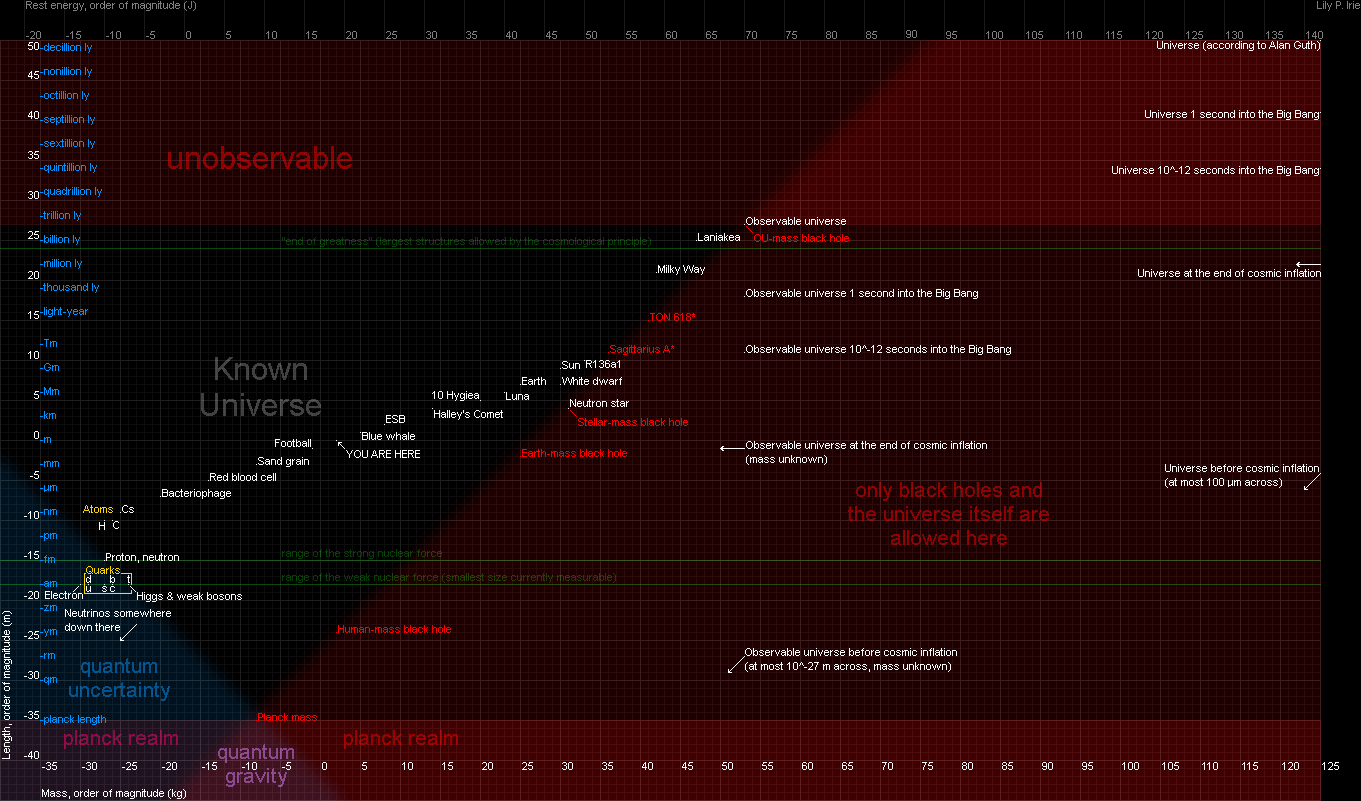
Hopefully it's mostly straightforward enough. Because I love when things are aligned to the grid, everything is rounded up to the nearest power of ten - a person weighs on the order of 100 (10^2) kilograms and is on the order of 1 (10^0) metre tall; Earth is on the order of 10 million (10^7) metres and 10^25 kilograms, et cetera.
You can see that most things we're familiar with seem to be on a line, a "main sequence" of sorts. They generally get more massive in proportion to their size - bigger things tend to be more dense, probably due to the square-cube law or more gravity or something of the sort. Black holes seem to be pretty much on a straight diagonal line from the bottom left to the top right, which is expected since the size of a black hole's event horizon is proportional to its mass. The line all these black holes lie on represents all possible Schwarzchild radii. If any mass is compressed down to its corresponding Schwarzchild radius, it will collapse into a black hole.
Interestingly, the "Main Sequence of Things" approaches the black hole line as the scale increases, and the observable universe ends up on the same order of magnitude as a black hole with its mass (in fact, it's significantly smaller). This has led to the hypothesis that our universe may be a giant black hole itself. There are indeed some interesting similarities, which I'll talk about in another post someday. You may be wondering why the observable universe doesn't collapse into a black hole if it's denser than one. It is in fact trying its hardest to do that, but dark energy is too strong at that scale and only accelerates the expansion of everything.
The "black hole line" separates the known Universe from the realm hidden within event horizons. Any object in the large red region will inevitably be crushed by its own gravity and become a black hole, unless that object is the entire Universe. The Universe can be denser than a black hole if it's uniform enough, which it evidently was during the Big Bang.
On the other side of the scale is another abyss, shown here as blue, where quantum effects start to make everything weird and uncertain. The planck mass is where these abysses meet; oddly unlike many other planck units, it isn't that crazy in terms of magnitude - a large grain of sand has about the planck mass. Where the two realms overlap, the unknown laws of quantum gravity govern whatever exists down there.
At the very top, rest energy in joules is plotted on the same axis as mass. Rest energy is the E in the famous equation E=mc^2, so by a simple conversion we can deduce that a kilogram of mass corresponds to about 100 million billion joules of rest energy.
At the very top right is the entire Universe according to a shot-in-the-dark estimate of its size by Alan Guth, the cosmic inflation guy. This estimate is also used in my interactive Scale of The Universe thingy. Of course, no one actually knows how large the entire Universe is; it could be smaller than the observable part, or it could be infinite. The size of the Universe at various stages of the Big Bang is extrapolated from that of the observable universe, since it's believed that the whole Universe expands uniformly. If Alan Guth was correct, our universe was no bigger than a grain of sand before cosmic inflation.