Continuing the cool diagram series, here's a sequence of drawings showing the scale of the Universe. You can navigate using the links next to the title.
x20 << 1 pixel = 12,500 km >> x20
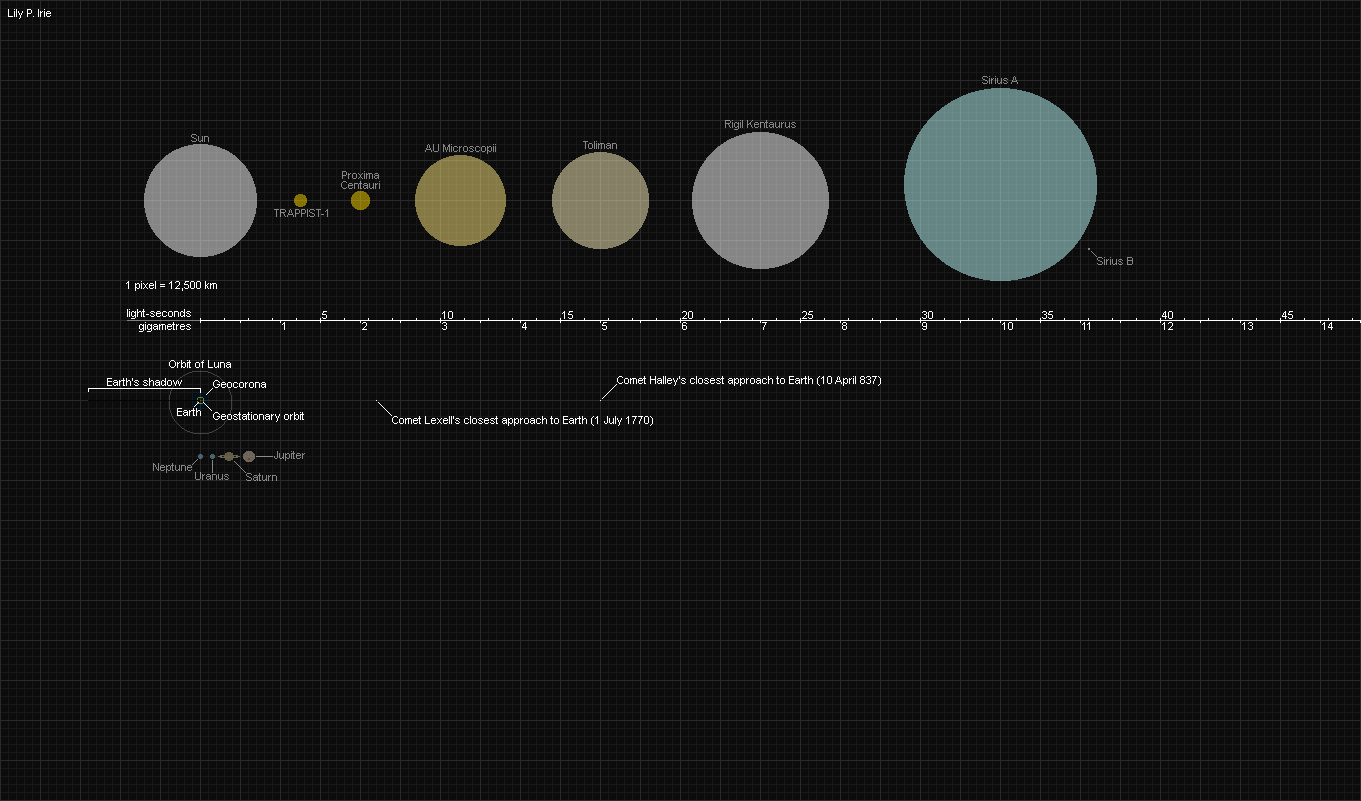
Zooming out by another factor of 20, a pixel here represents nearly the diameter of the Earth, meaning our whole planet that's already several million times the size of a person is now barely a single pixel. More stars are added for comparison - one of the largest known "red" dwarfs AU Microscopii; the three stars of the Alpha Centauri system; and Sirius A, the brightest star in our night sky.
The whole length of Earth's shadow is visible. It's about 1.4 million kilometres long - the maximum distance from which the Earth can fully block the Sun. Since Earth is about four times wider than Luna, and Luna appears to almost perfectly cover the Sun from Earth, this distance is about four times the orbital distance of Luna.
Note that the two comets mentioned here were not actually in those positions during their closest approach to Earth; this series aims to show the distances themselves rather than serve as a map of the Universe. If you want to see that instead, check out the Powers of Ten mode in Dimension.
You may notice that Earth isn't exactly in the centre of Luna's orbit. As mentioned one the previous page, Luna's distance from Earth varies by a few thousand kilometres over the course of its ~27-day orbital period. Earth is situated in one of the foci (singular: focus) of the lunar orbit.