Here's a sequence of drawings showing the scale of the Universe. You can navigate using the links next to the title.
x50 << 1 pixel = 12.5 million km >> x10
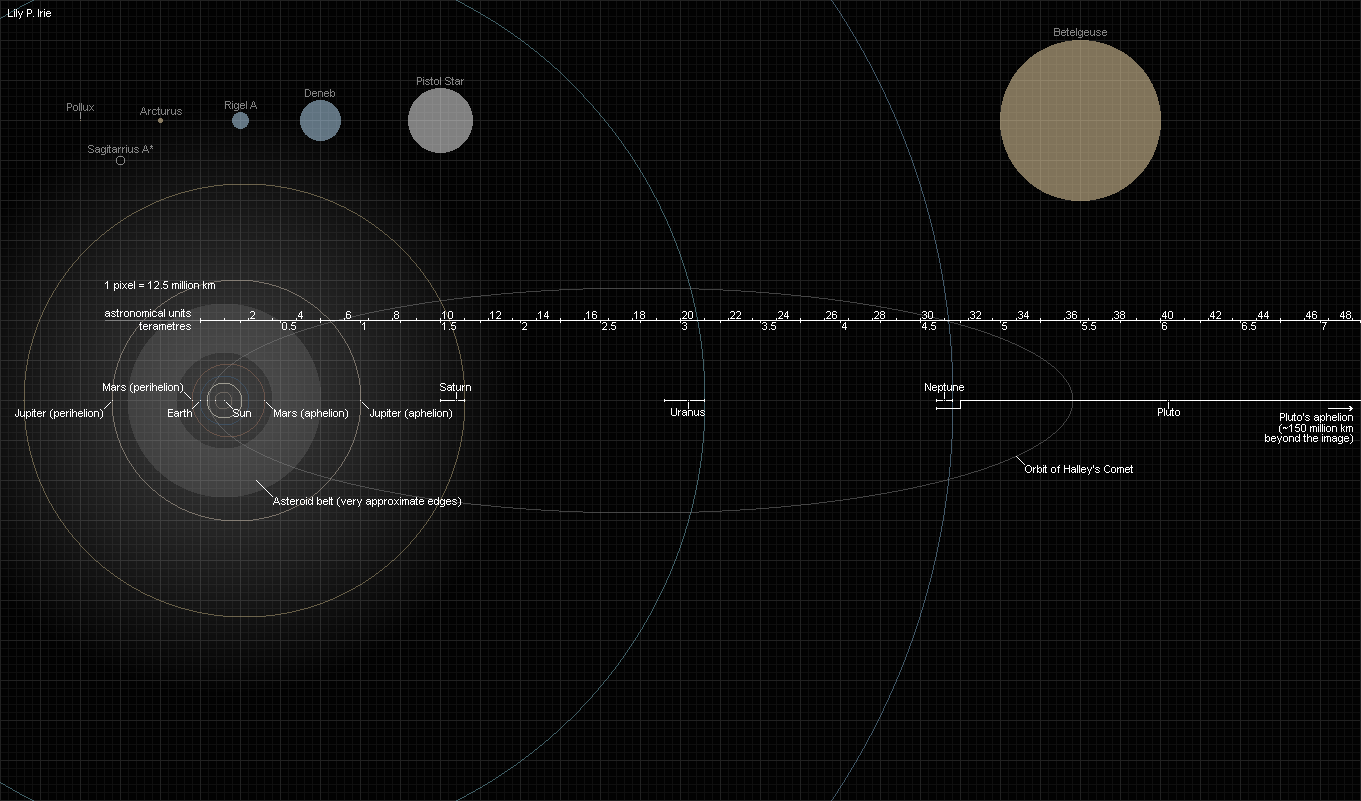
Zooming out another 50 times, even the Sun would now be smaller than a pixel, so all these white dots are now much bigger than the things they represent. The whole inner Solar System and much of the outer Solar System are within view. Once again, the orbits have been aligned with each other to better show their relative size and shape.
The orbital distance of each planet varies; the dots representing the planets are placed at their semi-major axis distance. Pluto's orbit is so eccentric that even though its perihelion is around the same as that of Neptune, its aphelion is so far out that it doesn't fit in this image.
The asteroid belt is shown schematically as a ring between Mars and Jupiter. Millions of asteroids orbit there, but they are often just a few kilometres across and farther apart than Earth and Luna, so you'd be lucky to spot one asteroid from the surface of another. Our spacecraft have no trouble crossing the asteroid belt. Many more city-sized rocky and icy bodies orbit somewhere within this image, one of them being Halley's Comet, whose orbit is included for reference. There are also dozens of dwarf planets like Pluto orbiting mostly beyond Neptune and forming the sparse Kuiper belt.
Four more stars are added for scale, as well as the event horizon of Sagittarius A*, our galaxy's central black hole. While the supergiant Betelgeuse is only about ten times more massive than our sun, Sagittarius A* weighs in at 4 million solar masses, all compressed into an unknowably dense speck surrounded by an inescapable space about 40 times the size of the Sun.
Light travels about 1.1 billion kilometres per hour and would take about 7 and a half hours to cross this image.