Here's a sequence of drawings showing the scale of the Universe. You can navigate using the links next to the title.
x500 << 1 pixel = 62.5 billion km
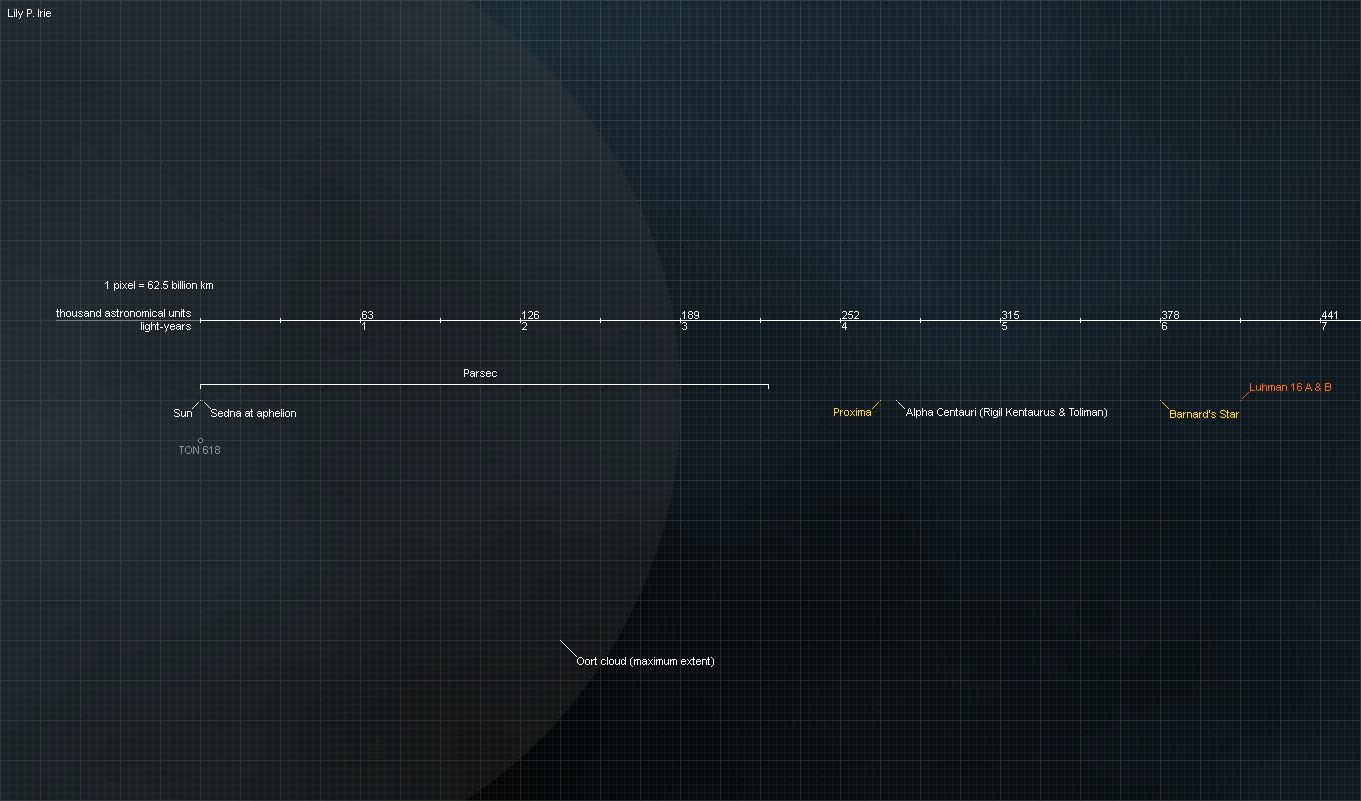
Taking another huge leap over 2 orders of magnitude, we find ourselves in interstellar space. The largest axis of Sedna's orbit now fits within a mere 3 pixels. Light takes almost 2 and a half days to traverse the side of one pixel here. A light blue haze represents the interstellar medium, an incredibly sparse plasma of charged particles that fills the space of our galaxy.
This might be a good time to pause for a moment and appreciate the sheer vastness at play. The white pixel showing the position of the Sun actually contains everything out to 31.3 billion kilometres from it, including all the planets and even the most distant of our spacecraft. And the whole image consists of about 1.1 million such pixels. Compressing these vast distances to fit on your screen really undersells just how unimaginably colossal the area shown in this picture is.
Three star systems are known to lie within 7 light-years of our sun - four if you consider Proxima to be its own system, as it visibly sits quite far away from Alpha A & B. Again, for the purpose of this series the stars have been put on a straight line while maintaining their distance from us. Despite being the nearest star to the Sun, Proxima is so dim that you need binoculars or a telescope to see it from Earth even as a glowing point. The two sunlike stars of Alpha Centauri orbit each other at a distance varying from 11 to 36 astronomical units, which is still too small to make them distinguishable at this scale. Remember: each pixel here is ten times the size of Pluto's orbit. The fourth-closest star to us is Barnard's Star, a red dwarf like Proxima. Last is the binary brown dwarf Luhman 16, a pair of objects that are inbetween gas giants and stars in mass.
The Oort cloud is a roughly spherical nebula of icy rocks believed to be orbiting the Sun at huge distances, potentially as far as the Sun's gravity can possibly hold onto something, which is around 2-3 light-years. On occasion these planetesimals are knocked out of their orbits and enter the domain of the planets, evaporating in the Sun's heat and becoming comets. If our Sun has an Oort cloud, it's likely that many other stars do as well.
A parsec is the distance from Earth at which a hypothetical star would have a parallax (maximum shift caused by the Earth going around the Sun) of 1 arcsecond, which is 1/3600th of a degree. In other words, it's the distance from which Earth's orbit would appear 1 arcsecond wide, or about 1/1800th as wide as the Sun and the Moon appear in our sky.
The only object added for scale here is the event horizon of TON 618*, the central black hole of a distant quasar and one of the largest black holes known. This is based on one of the most recent estimates for its mass - around 40 billion Suns. TON 618* is arguably one of the most massive known single objects in the Universe.